
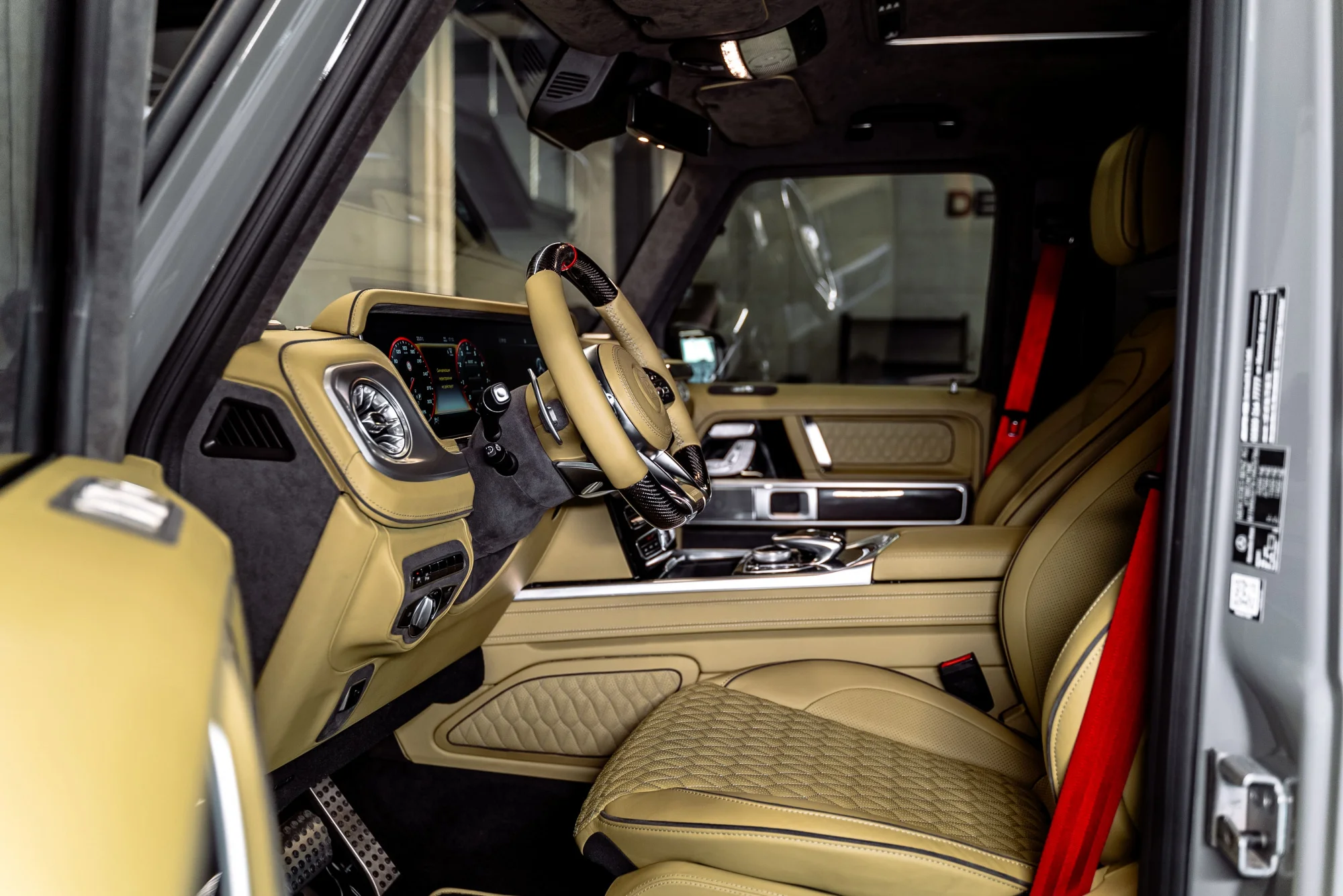
Before approving interior work for a BMW or Mercedes in the UAE, confirm six things in writing: the exact scope, safety-system handling, UAE compliance checks, material evidence, technical compatibility, and warranty terms. The attractive sample is not the hard part. The hard part is making sure the finished interior still supports the vehicle's original functions, including airbags, seat controls, ventilation, memory settings, lighting, sensors, and warning systems where fitted.
Interior work is any planned change to cabin components, finishes, upholstery, trim, lighting, or related factory interior systems. It can be limited to one steering wheel or seat panel, or it can cover a full cabin rebuild. A well-specified order gives the workshop enough detail to price the work accurately and gives the owner a clear basis for acceptance.
A BMW or Mercedes interior may look simple once trim is removed. It isn't. Behind one seat cover can sit wiring, occupancy sensors, heating elements, ventilation channels, and airbag-related components. That's why the order should begin with documentation, not with a colour choice.
Full Interior Reupholstery
A clear project brief prevents mismatched quotations and avoids arguments about what was included. The owner should define every affected component, the preferred appearance, and every factory function that must remain operational after the work is completed.
Full Interior Reupholstery — interior retrim — is a complete interior rebuild: seats, door panels, steering wheel, headliner and trim. This is different from replacing a single damaged seat panel or refinishing one trim piece. The scope changes the price, production time, material quantity, and technical risk.
A quote for "Mercedes interior" is too broad. The workshop needs the model, model year, trim level, body style, VIN, and factory options that affect the cabin. AMG, M Sport, individual upholstery packages, massage seats, panoramic roofs, and different dashboard layouts may require different materials or installation methods.
What should be included in the first request
Send the workshop a written brief with the following information:
- Vehicle make, model, model year, trim level, body style, and VIN.
- Clear images of seats, dashboard, door panels, steering wheel, headliner, console, and damaged areas.
- A list of components to be removed, replaced, retrimmed, or refinished.
- The desired material, colour, stitching, perforation, piping, embossing, and surface finish.
- Factory features that must continue to work after installation.
- Known faults such as damaged foam, broken clips, warning lights, loose trim, or seat-control issues.
- A request for written confirmation of the included components and excluded work.
The last point matters. A price can cover new upholstery but exclude foam repair, trim clips, seat removal, refitting, diagnostics, or electrical work. Those are different operations and should not be left to assumptions.
| Project element | What the owner should specify | Why it affects the order |
|---|---|---|
| Seats | Number of seats, material, perforation, stitching, headrests, armrests | Seat design determines pattern work and compatibility checks |
| Door panels | Inserts, handles, speaker grilles, ambient-light sections, trim finish | Door-panel work can affect clips, wiring, and lighting |
| Steering wheel | Leather type, stitching, carbon or trim inserts, control retention | Switchgear and heating functions may need protection |
| Dashboard and console | Panels to be refinished or replaced, colour match, trim material | The finish must match nearby factory components |
| Headliner | Material, pillars, sunroof or panoramic-roof configuration | Roof geometry determines the installation approach |
| Factory functions | Heating, ventilation, memory, massage, lighting, sensors | Functional requirements set the technical scope |
Full Interior Reupholstery is available from 30,000 AED (lowest vehicle-class entry), subject to the confirmed scope for seats, door panels, console, and dashboard. Custom projects are priced from 120,000 AED. The number alone is less useful than the written scope behind it.
Check UAE legality and safety before modifying the interior
Interior work should not be approved until the owner has asked the workshop how the planned changes will be checked against current UAE requirements. This is especially relevant when the work affects safety systems, vehicle controls, warning indicators, structural seat components, or equipment that may require inspection or registration-related confirmation.
Safety systems refer to airbags, seat-belt systems, occupancy sensors, emergency controls, and related occupant-safety systems. Access to a component is not the same as confirming that it will operate correctly after the vehicle is reassembled.
An airbag seam can be hidden beneath new upholstery. A seat-belt buckle can be removed during retrimming. A sensor may be disconnected while a seat is out of the vehicle. Each case needs a documented handling plan because the finished cabin can look perfect while a function behind it has not been checked.
Safety areas that require a pre-order assessment
| Area | What to ask before approval | Evidence to request |
|---|---|---|
| Seat-mounted airbags | Will the original airbag zones and deployment seams be preserved? | Written handling method and post-installation inspection plan |
| Seat-belt systems | Will belt routing, buckles, pretensioner areas, and mounting points remain unchanged unless assessed? | Confirmation of work boundaries |
| Occupancy sensors | Will seat occupancy detection be checked after reassembly where fitted? | Diagnostic or functional-check procedure |
| Seat wiring | How will connectors, looms, and mounting points be protected during removal? | Photo documentation or work notes |
| Emergency controls | Will seat adjustment and release functions remain accessible? | Final acceptance checklist |
| Warning lights | Will the vehicle be checked for warnings after installation? | Delivery briefing record |
Ask direct questions. Will the workshop remove seats? Who handles airbag-related trim? What happens if a warning light appears after reassembly? Is diagnostic work included in the estimate or treated as separate work? Can the workshop state which UAE compliance checks the owner should complete before and after the modification?
A workshop should never answer safety questions with vague reassurance. "We do this all the time" is not a process. A written method is.
Why cosmetic work can become a safety issue
The common belief is that upholstery is only cosmetic. That stops holding when the upholstery covers a seat-mounted airbag zone, a sensor mat, or an electrical heating element. New material affects the result through thickness, perforation, backing, stitching, and installation method.
A seat cover may look correctly fitted but still interfere with a component beneath it. Because of that risk, professional assessment should happen before cutting material, not after the car is ready for collection.
Require the workshop to document its handling and post-installation checks for every affected safety-related component.
Choose materials suitable for UAE heat and UV exposure
Materials for a BMW or Mercedes cabin in the UAE should be selected for heat exposure, UV resistance, wear, cleaning needs, and suitability for the specific component. Appearance matters, but it does not replace performance evidence. A light-coloured leather sample may look excellent under workshop lighting and behave differently after repeated exposure to high cabin temperatures.
Certified materials are materials supported by test records, supplier documentation, or quality certificates relevant to their intended use. The owner should ask to see the evidence, not accept the phrase "premium material" as proof.
Heat and UV exposure affect colour stability, surface feel, adhesive behaviour, and long-term appearance. A dashboard insert and a seat bolster face different forms of wear. One sees sunlight through the windscreen; the other faces friction from entry and exit. They should not automatically be specified the same way.
| Material question | What to check | Why it matters in UAE conditions |
|---|---|---|
| Heat resistance | Supplier evidence for high-temperature performance | Cabin heat can affect surface stability and backing materials |
| UV resistance | Test evidence or certificate for colour and finish retention | UV exposure can change colour and surface appearance |
| Wear resistance | Suitability for bolsters, steering wheels, armrests, and seat centres | High-contact areas need a material matched to friction |
| Cleaning requirements | Approved cleaning method and prohibited products | Incorrect care can damage coatings or finishes |
| Perforation | Compatibility with ventilated-seat layout where fitted | Incorrect perforation can affect airflow and appearance |
| Backing and thickness | Whether the material suits the intended panel or seat design | Thickness can affect fit, seams, and factory functions |
Natural leather and synthetic leather require different care methods and can respond differently to heat, seams, and perforations. Confirm the cleaning products and protection method for the selected material. Neither option is automatically right. The right choice depends on the component and the agreed finish.
Approve a physical sample before production
A photograph is useful for direction. It is not final approval. Ask for a physical sample and compare it with the existing interior in daylight and under cabin lighting. Check grain, shade, perforation size, stitch contrast, and how the material sits next to factory trim.
This is where many expensive mistakes begin. The material may be technically suitable but visually wrong beside the original dashboard, console, or door trim. Or it may look right in a sample book and prove unsuitable for a ventilated seat.
Request these documents before final approval:
- Material name, supplier, and product reference.
- Available certificate or test evidence.
- Care and cleaning instructions.
- Confirmation of intended component use.
- Sample approval record showing colour, finish, and stitching choice.
Check BMW and Mercedes technical compatibility
BMW and Mercedes interior systems must be assessed before upholstery removal, trim replacement, or wiring changes. Heated seats, ventilated seats, memory functions, occupancy sensors, ambient lighting, steering-wheel controls, switchgear, and seat adjustment systems can all affect the work plan.
BMW and Mercedes interior systems refer to factory interior electronics and mechanical features that support comfort, control, information, or occupant safety. A workshop should identify affected functions before dismantling begins and state how they will be checked afterward.
For this order, request documented examples of completed BMW or Mercedes interior work that match the exact task. Retrimming a ventilated seat is not the same job as refinishing a dashboard insert.
Compatibility checks by component
| Component | Features to confirm | What may be needed after installation |
|---|---|---|
| Front seats | Heating, ventilation, memory, massage, occupancy sensors, seat-mounted airbags | Functional check, diagnostics, calibration, or coding where applicable |
| Steering wheel | Heating, multifunction controls, paddles, airbag module | Control and warning-light check |
| Door panels | Speakers, ambient lighting, switches, wiring connectors | Function test for lighting, switches, and speakers |
| Dashboard | HUD openings, vents, screens, controls, trim clips | Alignment and function check |
| Centre console | Drive-mode controls, charging areas, switches, lighting | Operational check after refitting |
| Roof and headliner | Lighting, microphones, sunroof controls, panoramic-roof arrangement | Function test for affected roof equipment |
Assess roof vibration and noise insulation against the vehicle's roof configuration and the planned headliner work. Include it in the scope only where the inspection identifies a requirement.
A written restoration plan protects both sides
Ask for a short plan stating:
- Which factory components will be removed.
- Which functions will be tested before work starts.
- Which connectors, sensors, and controls may be affected.
- Whether coding, calibration, or diagnostics may be required.
- Which final checks will be completed before delivery.
The plan can be brief, but it must identify the affected components, tests, and final checks. If the workshop cannot identify what sits beneath a proposed trim panel, it cannot responsibly promise that the original function will remain unchanged.
Evaluate the workshop before placing the order
A workshop should be chosen on relevant completed work, technical competence, process control, and documented responsibility. A polished social-media image does not prove that the team can rebuild a BMW or Mercedes seat with ventilation, memory wiring, and safety-related trim.
Look for real projects that match the car and the requested scope. A portfolio should show more than finished wide-angle photographs. Ask for close images of stitching, panel alignment, perforation, steering-wheel seams, door-card edges, seat bolsters, and integration around switches or lighting.
What separates evidence from presentation
| Evaluation point | What to request | What it shows |
|---|---|---|
| Relevant portfolio | Completed BMW or Mercedes interiors similar to the requested work | Experience with comparable cabin layouts |
| Vehicle details | Model, generation, and scope of past work | Whether the example is relevant |
| Close-up quality | Images of seams, panel gaps, trim edges, and perforation | Finishing standard beyond a distant photo |
| Staff competence | Who handles upholstery, electronics, diagnostics, and safety-related parts | Whether the work has defined responsibility |
| Process documentation | Inspection notes, estimate, work stages, quality-control record | Whether the workshop can track the job |
| Vehicle custody | Storage, handover procedure, and point of contact | Clear responsibility while the car is in the workshop |
DEIZ GARAGE describes its process as: inspection and diagnostics; clear scope, estimate, and timeline; production, installation, and finishing; then quality control and delivery briefing. This sequence is useful because it creates decision points before materials are cut and again before the vehicle is accepted.
DEIZ GARAGE states that it does not outsource to contractors and keeps work under one roof. For any workshop, the owner should ask the same practical question: who performs each stage, and who is accountable if the result needs correction?
Questions that reveal the working method
Ask who will dismantle the interior, who will handle wiring, who approves material samples, and who performs the final inspection. Ask whether the same team has worked on the relevant BMW or Mercedes generation. Ask how pre-existing damage is recorded before work starts.
Then ask the awkward question: what happens if a factory function does not operate after reassembly? The answer should identify the next step, the responsible person, and the inspection process. Anything less leaves the owner carrying the uncertainty.
Confirm warranty, acceptance, and after-sales support
The written order should separate material warranty from workmanship warranty, define acceptance criteria, and state how after-sales issues will be handled. A warranty has little value if it does not say what is covered, what is excluded, and who decides whether the issue is a material defect or an installation defect.
Material warranty refers to coverage for the supplied material. Workmanship warranty refers to coverage for the quality of installation, stitching, fit, and agreed finishing work. They are not interchangeable.
Before placing an order, require the written agreement to state the exact warranty terms for the selected interior work. It should identify the coverage duration, covered defects, exclusions, care conditions, claim process, and responsibility for material issues and installation defects.
| Document item | What should be stated |
|---|---|
| Scope | Components included, components excluded, and any optional work |
| Materials | Product name, colour, finish, perforation, stitching, and approved sample |
| Price | Agreed price structure and any conditions for additional work |
| Timing | Start date, expected completion, and approval points |
| Technical work | Diagnostics, coding, calibration, or functional checks where applicable |
| Workmanship warranty | Coverage period, covered defects, and exclusions |
| Material warranty | Supplier terms, care conditions, and exclusions |
| Acceptance | Inspection method, delivery briefing, and defect-reporting process |
| After-sales service | Contact method, response process, and adjustment procedure |
Inspect the vehicle before accepting it
Use a delivery checklist. Do not rely on a quick glance in the workshop reception area.
- Inspect material colour and finish in good light.
- Check seams, perforation, piping, panel alignment, and trim edges.
- Test every affected seat adjustment and control.
- Confirm heating, ventilation, memory, massage, lighting, switches, and speakers where fitted.
- Check that warning lights are not present.
- Confirm seat-belt access and buckle operation.
- Review the quality-control record and delivery briefing.
- Record any defects in writing before final acceptance.
Quality control and delivery briefing should be part of the handover, not an informal favour. The vehicle is not fully accepted until the owner has checked the agreed appearance and the functions affected by the interior work.
A documented order reduces expensive surprises
A documented interior order can reduce uncertainty compared with an order based only on price or appearance. It connects the vehicle specification, material choice, safety assessment, technical plan, workshop process, and warranty conditions in one written record.
Start with the car's real configuration. Approve physical material samples. Require the workshop to state how it will preserve or restore factory functions. Then inspect the finished vehicle before accepting it.
That is the work.
What to expect before booking
Before booking, send the workshop the VIN, model details, factory options, and clear photographs of the affected areas. Include the desired material, finish, colour, stitching, and a list of factory functions that must remain operational.
The next step should be an inspection and diagnostics review, followed by a written scope, quotation, timeline, and technical plan. The order should identify what will be removed, retrimmed, replaced, tested, and excluded.
At delivery, expect a quality-control review and briefing. Inspect the agreed finish, test the affected functions, review any recorded issues, and keep the written warranty and after-sales contact details.
FAQ
Questions BMW and Mercedes owners ask before ordering interior work
What should BMW and Mercedes owners check before ordering interior work?
Check the exact scope, vehicle specification, factory interior systems, material evidence, safety-system handling, workshop portfolio, written quote, workmanship warranty, material warranty, and final acceptance process.
What should be checked before ordering interior reupholstery for a BMW or Mercedes?
Confirm which seats and trim panels will be retrimmed, whether airbags or sensors are present, whether heating or ventilation must remain functional, and whether the selected material suits the intended component.
Which documents should be requested from the workshop?
Request a written quotation, approved material specification, available certificates or test evidence, work scope, timeline, warranty terms, technical-check plan, and final delivery checklist.
Which safety features should be checked before work starts?
Check seat-mounted airbag zones, seat-belt systems, occupancy sensors, seat wiring, emergency controls, and any warning-light or diagnostic procedure relevant to the planned work.
Which final checks should be completed before accepting the vehicle?
Inspect material quality, seam alignment, panel fit, trim edges, affected seat functions, lighting, controls, warning lights, and the documented quality-control result.
